
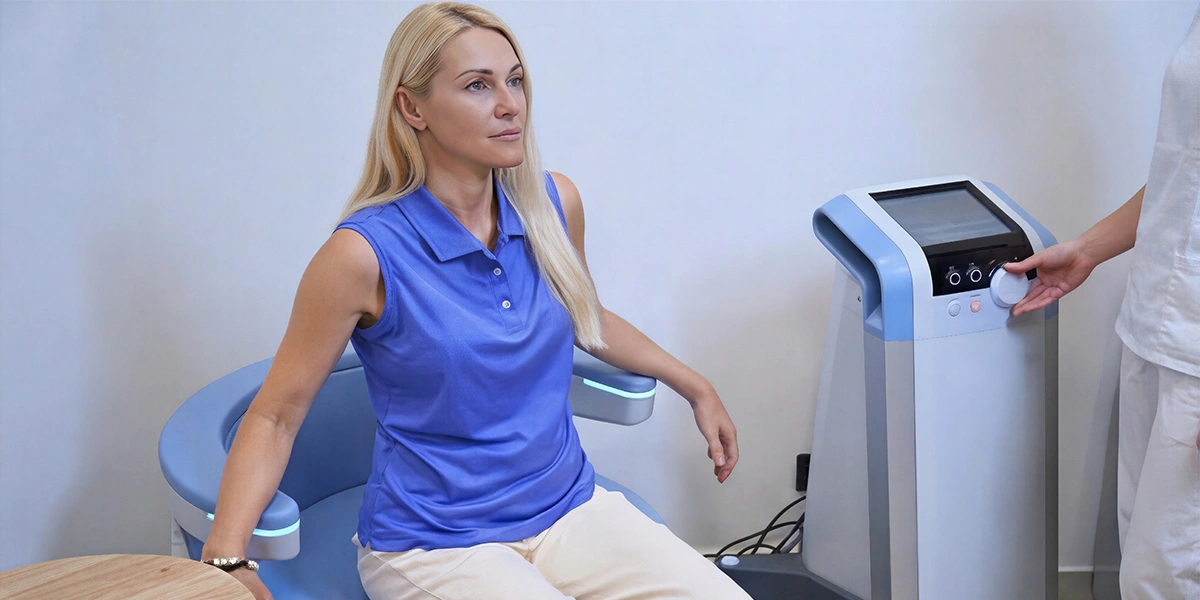
Urinary incontinence can have a negative impact on daily living, confidence, sleep, exercise, health and quality of life. Although urinary incontinence is common, some people delay seeking medical advice because they believe it is an inevitable consequence of aging, childbirth or pelvic health changes.
There are several non-surgical and conservative treatment options available to treat urinary incontinence. The EMSELLA chair is one of the new technologies that has been introduced, which stimulates and strengthens the pelvic floor muscles in a non-invasive way.
So, what is EMSELLA treatment, how does it work and who would benefit from it? This guide gives you information about how it is treated, what its benefits are, what you can expect at a session, and its costs.
Table of Contents
- What Is EMSELLA Treatment?
- Understanding the Connection Between EMSELLA and the Pelvic Floor
- How Does the EMSELLA Chair Work?
- Can EMSELLA Help with Urinary Incontinence?
- EMSELLA vs Kegel Exercises: What’s the Difference?
- What Are the Main EMSELLA Chair Uses?
- EMSELLA Chair Benefits
- What Does an EMSELLA Treatment Feel Like?
- How Many EMSELLA Treatments Are Usually Needed?
- Cost of EMSELLA Treatment
- EMSELLA Chair for Erectile Dysfunction: What Should Men Know?
- Is EMSELLA Suitable for Everyone?
- Why a Professional Assessment Matters
- Frequently Asked Questions About EMSELLA
- Final Thoughts
What Is EMSELLA Treatment?
EMSELLA is a non-invasive treatment that uses high-intensity focused electromagnetic (HIFEM) technology to activate the pelvic floor muscles. The treatment does not require surgery or an internal applicator; instead, the patient sits on an EMSELLA chair while electromagnetic energy stimulates repeated pelvic floor muscle contractions.
The contractions are designed to strengthen and re-educate the muscles that support the bladder and the pelvis. Preliminary clinical studies have evaluated HIFEM treatment for patients with stress and mixed urinary incontinence and have shown that the treatment can be effective for alleviating urinary incontinence symptoms.
Use of EMSELLA may be considered for use in a comprehensive treatment program following a proper medical evaluation. If bladder leakage has been ongoing for a long time, patients should discuss with the Urology Department about the cause and the treatment options.
Understanding the Connection Between EMSELLA and the Pelvic Floor
The pelvic floor consists of a set of muscles that can assist the structures in the pelvis and aid in bowel and bladder control. If these muscles get weak or coordination is altered, urine can leak out.
Pelvic floor weakness can be caused by pregnancy and childbirth, aging, menopause, medical conditions, pelvic surgery and more.
The principle behind EMSELLA pelvic floor treatment is to repeatedly engage these muscles while maintaining a seated position. The aim is to increase the strength of the muscles and their nerve control.
But not all urinary leaks are caused by just weak pelvic floor muscles. This is why it’s crucial to have an assessment by a qualified healthcare professional before beginning the treatment.
Other gynaecological conditions, such as menopause, surgery, and pregnancy and childbirth, can lead to pelvic health issues in women, which is another reason why they should seek an in-depth evaluation from the experts at Obstetrics and Gynaecology.
How Does the EMSELLA Chair Work?
The patient is fully clothed when using EMSELLA, while seated in the chair. The chair produces a concentrated electromagnetic signal that stimulates nerves, activating the muscles of the pelvic floor and triggering multiple muscle contractions.
It can be broken down into a few simple steps:
- The patient is seated comfortably on the EMSELLA chair.
- The position for treatment is modified.
- HIFEM energy energizes contractions in the pelvic floor muscles.
- The muscles are exercised in a series of contractions and relaxations during the session.
- At the end of the session, patients are usually able to resume their normal daily routines.
Treatment duration may vary depending on the clinical protocol. Published EMSELLA studies have commonly evaluated treatment courses involving multiple sessions, with improvements in urinary incontinence symptoms reported following treatment.
Can EMSELLA Help with Urinary Incontinence?
Conservative measures to strengthen the pelvic floor may be important for some urinary incontinence.
Studies evaluating HIFEM-based EMSELLA treatment have reported promising findings for stress and mixed urinary incontinence. In one study involving 35 women, symptom scores decreased after six treatment sessions and at one-month follow-up.
Individual results may differ, however. Treatment is effective depending on the type and severity of incontinence, pelvic floor function, medical history, and other factors.
It is also important to determine whether urinary leakage is related to another condition. Understanding common urology problems can help patients recognize possible causes of their symptoms and know when to seek an assessment from a urologist.
EMSELLA vs Kegel Exercises: What’s the Difference?
| Feature | EMSELLA | Kegel Exercises |
|---|---|---|
| How it works | Uses electromagnetic energy to stimulate pelvic floor muscle contractions automatically. | Involves consciously contracting and relaxing the pelvic floor muscles. |
| Patient effort | The patient remains seated while the treatment stimulates muscle contractions. | Requires active participation and regular practice. |
| Technique | Muscle stimulation is delivered through the EMSELLA chair. | Correct technique is important for effectively targeting the pelvic floor muscles. |
| Consistency | Treatment is typically provided in scheduled sessions. | Requires consistent practice over time. |
| Role in rehabilitation | May be included as part of a pelvic floor treatment or rehabilitation plan. | Can be an important component of pelvic floor rehabilitation. |
| Can they be combined? | Yes. A healthcare professional may recommend EMSELLA alongside pelvic floor exercises depending on individual needs. | Yes. Structured Kegel exercises may be used alongside other pelvic floor treatments. |
What Are the Main EMSELLA Chair Uses?
The most talked-about use of the EMSELLA chair is for urinary incontinence and strengthening the pelvic floor; however, the uses of the chair may vary based on patient condition and clinical setting.
It may be considered for people experiencing:
- Stress urinary incontinence
- Mixed urinary incontinence
- Pelvic floor weakness
- Bladder leakage associated with weakened pelvic floor support
- Pelvic floor changes following childbirth
- Certain cases of urinary leakage in men after prostate treatment or surgery
Because bladder symptoms can have several different causes, EMSELLA should not be viewed as a universal solution for every urinary problem.
It’s important for men to keep their prostate healthy and to talk to a doctor if they have any prostate-related symptoms, particularly after undergoing a procedure or condition that affects the prostate.
EMSELLA Chair Benefits
This procedure is non-invasive and might be of interest to patients. The EMSELLA chair offers a number of benefits that have been discussed, such as:
- No surgical incisions
- No injections
- Patients generally remain fully clothed
- Sessions are relatively short
- No internal applicator is required
- Treatment focuses on pelvic floor muscle stimulation
- Little or no downtime is generally required
Another benefit to this is convenience. The typical session lasts about 28 minutes; Most patients go back to their normal lives afterwards.
However, experiences with treatment may differ from person to person, and only an experienced professional can indicate the treatment experience.
What Does an EMSELLA Treatment Feel Like?
Patients often find that the contractions are recurrent, a strong tightening, or tingling. During the treatment, sensation is felt in the pelvic floor area.
The intensity will usually be adjusted based on comfort levels and treatment needs. The contractions may be strange or strong, but they are usually tolerable.
Normally, there is no need for injections, anesthesia, or surgical preparation.
How Many EMSELLA Treatments Are Usually Needed?
There is no single treatment schedule that is suitable for all.
A six-session course has been the subject of published clinical research and is offered at two sessions a week in many cases. In one study that looked at HIFEM for stress and mixed urinary incontinence, six 28-minute sessions were performed.
The actual number of recommended sessions may vary, depending on:
- Severity of symptoms
- Type of urinary incontinence
- Pelvic floor condition
- Previous treatment
- Medical history
- Response to initial sessions
Therefore, a consultation is necessary before determining the number or frequency of treatments.
Cost of EMSELLA Treatment
There is no standard price for EMSELLA treatment, as the cost can vary depending on the clinic, location, and individual treatment plan. The overall price may be influenced by several factors, including the cost of an individual session, the number of recommended sessions, the need for consultation, the healthcare provider, and whether EMSELLA is used as part of a broader pelvic floor rehabilitation programme.
The number of sessions recommended may vary according to the patient’s clinical needs and assessment. Therefore, the overall cost of an EMSELLA treatment course may also vary.
While cost is an important factor to consider, patients should also take into account the experience and qualifications of the healthcare team, the quality of the clinical assessment, the recommended treatment plan, and the availability of post-treatment support.
A consultation at Canadian Medical Center can help determine whether EMSELLA is appropriate for your needs and provide a personalized treatment plan, including the recommended number of sessions and associated costs.
EMSELLA Chair for Erectile Dysfunction: What Should Men Know?
There is also some information that can be found online regarding the EMSELLA chair for erectile dysfunction since the pelvic floor muscles play a role in various parts of male pelvic functions.
But there are a number of possible causes for erectile dysfunction: vascular, hormonal, neurological, psychological, medication-related, and other health issues. EMSELLA should not, therefore, be marketed as a ‘cure’ or ‘standard treatment’ for erectile dysfunction.
Any man with erectile dysfunction, urinary leakage or other changes that affect pelvic function should first have an appropriate medical evaluation. A doctor can determine the underlying causes and discuss the available and proven treatment options.
Is EMSELLA Suitable for Everyone?
Not necessarily. As with any medical intervention, an evaluation is necessary prior to treatment with EMSELLA.
It is important that the patient gives their healthcare professional a full medical history such as pregnancy, previous surgery, implanted medical or electronic devices, metal implants, and other relevant conditions.
This will then be assessed by a healthcare practitioner to see if it is suitable or whether another treatment for the pelvic floor or urinary incontinence would be more appropriate.
Why a Professional Assessment Matters
Urinary incontinence is not a disease itself, but a symptom. The causes of bladder leakages can be totally different for two people.
Urinary symptoms can, for instance, be related to pelvic floor weakness, bladder dysfunction, prostate problems, neurological problems, medication, infection or other medical problems.
A professional evaluation can be used to determine:
- What type of urinary incontinence you have
- Possible underlying causes
- Whether pelvic floor weakness is involved
- Whether EMSELLA may be appropriate
- Whether pelvic floor physiotherapy is recommended
- Whether further diagnostic tests are required
This individualized approach is crucial as it is important to first understand the source of the symptoms to achieve successful treatment.
Frequently Asked Questions About EMSELLA
How does the EMSELLA Chair work?
Using high-intensity focused electromagnetic technology, the EMSELLA chair stimulates repeated pelvic floor muscle contractions. This is meant to reinforce and retrain these muscles that are critical for bladder support and control of urine.
Can EMSELLA help with urinary incontinence?
EMSELLA has been investigated for the treatment of urinary incontinence, specifically stress urinary incontinence and mixed urinary incontinence, without causing damage to the bladder or urethra.
Is EMSELLA the same as doing Kegel exercises?
No. Kegel exercises require a person to voluntarily contract and relax the pelvic floor muscles. EMSELLA uses electromagnetic energy to stimulate pelvic floor contractions automatically. Depending on the individual, a healthcare professional may recommend pelvic floor exercises, EMSELLA, or a combination of approaches.
How long does an EMSELLA treatment session take?
An average EMSELLA treatment is about 28 minutes long. Treatment schedule and number of treatment sessions should be discussed and determined following assessment by a competent healthcare professional.
Can I stay fully clothed during an EMSELLA session?
Yes, one of the practical advantages of EMSELLA treatment is that patients generally remain fully clothed while sitting in the treatment chair. Your healthcare provider will explain any preparation or clothing recommendations before the session.
Final Thoughts
Pelvic Floor Muscle Stimulation (PFMS), which is supplied by EMSELLA, is a non-invasive method that may be beneficial for some cases of urinary incontinence. Bladder leakage may be due to different factors; however, EMSELLA may not be appropriate for all. It is essential to have a professional assessment to know what is going on and to evaluate whether EMSELLA or another treatment is suitable for you or not.

 Call Us